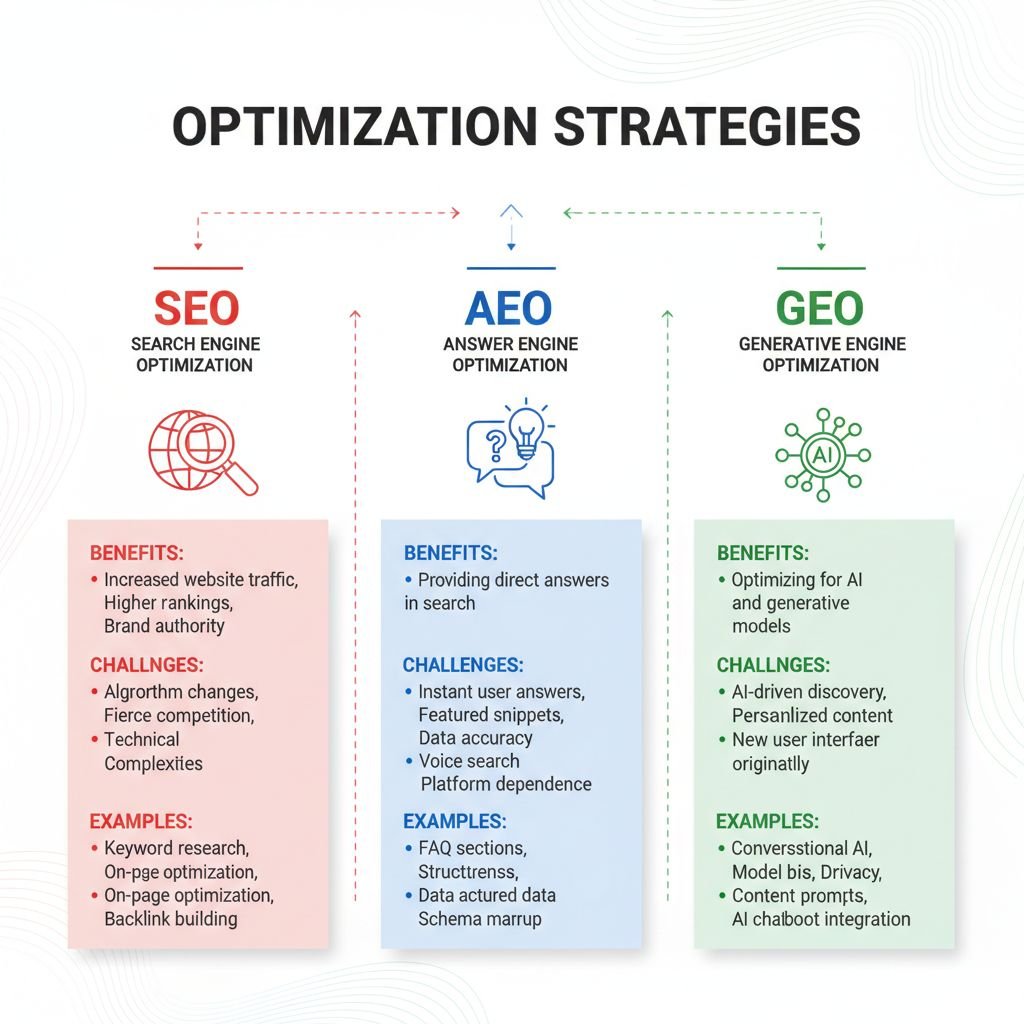
You might find yourself wondering about the differences between SEO, AEO, and GEO. These acronyms, though distinct, all play a role in how people find information online. We will clarify each concept, showing you how they interact and why understanding them matters for your digital strategy.
Defining the Core Pillars: SEO, AEO, and GEO
Understanding these three distinct, yet interconnected, optimization strategies is key to mastering modern online visibility. You will see how each plays a unique role in attracting and engaging your target audience across various search and information platforms.
The Foundation of Traditional Search Engine Optimization
You focus on optimizing your website and content to rank higher in traditional search engine results pages (SERPs). This involves keyword research, technical SEO, link building, and content creation, directly impacting organic traffic and visibility.
The Rise of Answer Engine Optimization and Generative Results
You now encounter a shift toward optimizing for direct answers and AI-generated summaries. This means your content needs to provide concise, accurate information that can be easily extracted and presented as a direct answer or incorporated into generative AI responses. This evolution extends beyond simply ranking; it’s about being the definitive source for a query, often without a user needing to click through to your site. You prepare your content for platforms like Google’s SGE or ChatGPT, where direct answers and synthesized information are becoming the norm. Your content must be structured to facilitate quick understanding and extraction by these advanced systems.
The Mechanics of Generative Engine Optimization (GEO)
You’re probably wondering how these generative systems actually work. GEO operates by optimizing for synthesized information, not just existing content. This involves understanding how large language models process and generate new text, a departure from traditional SEO’s focus on indexing and ranking.
How Large Language Models Synthesize Information
These models learn patterns and relationships from vast datasets. They don’t copy; they generate novel responses by predicting the next most probable word or phrase, creating coherent and contextually relevant content based on your prompts.
Key Differences Between Ranking and Citation Synthesis
Your goal with GEO shifts from merely ranking existing pages to influencing the synthesis of new, authoritative citations. This means optimizing for how your information is understood and reproduced by generative AI, rather than its position on a search results page.
You influence how generative AI constructs new information by providing clear, structured, and highly authoritative content. Traditional ranking focuses on algorithms determining visibility among pre-existing options. Citation synthesis, however, requires your content to be so well-defined and trustworthy that it becomes a foundational element for AI when it generates responses, importantly becoming a ‘cited’ source within the AI’s output, even if not explicitly linked.
Technical Requirements for Multi-Platform Visibility
Ensuring your content reaches every corner of the digital space demands a solid technical foundation. You need to consider how various platforms interpret and display your information, from search engines to social media and voice assistants. Optimizing your site’s backend and markup is key to achieving widespread visibility.
Leveraging Structured Data and Advanced Schema
Applying structured data correctly helps search engines understand your content’s context and relationships. This allows for rich snippets and enhanced search results, making your information stand out to potential users.
- Structured Data Elements Schema.org A universal vocabulary for describing entities on the web. JSON-LD A lightweight data-interchange format for structured data. Microdata An HTML specification for embedding structured data.
Optimizing for Natural Language and Conversational Queries
People are increasingly using natural language to search, whether typing full questions or speaking into voice assistants. Tailoring your content for these conversational queries is now a necessity for capturing a wider audience. Your content should directly answer common questions and anticipate follow-up inquiries. Think about how a person would verbally ask for information related to your topic. Structuring your content with clear headings, concise answers, and question-and-answer sections will greatly improve its chances of appearing in these natural language results. Consider long-tail keywords that reflect how people speak, not just how they type short phrases.
The Role of Authority and Trust in AI-Driven Search
Understanding AI’s reliance on authority and trust is key to mastering modern search. You’re not just optimizing for keywords; you’re building a credible digital presence that machines can trust. AI models prioritize sources demonstrating expertise, experience, authoritativeness, and trustworthiness (E-E-A-T) when delivering search results.
Establishing E-E-A-T for Machine Learning Algorithms
Demonstrating E-E-A-T for algorithms involves clear author bios, citations, and a history of quality content. You should ensure your expertise is evident across all your digital touchpoints, signaling to AI that your information is reliable.
The Increasing Importance of Digital PR and Brand Mentions
Positive brand mentions and strategic digital PR significantly influence your authority. Search engines interpret these as votes of confidence, strengthening your perceived trustworthiness. Your brand’s reputation, cultivated through consistent positive mentions and strategic digital PR, directly impacts how AI-driven search ranks your content. When respected publications or influential voices reference your brand, it signals to machine learning algorithms that your entity possesses authority and is a trusted source of information. These external endorsements act as powerful validation, telling search systems that your content is not only relevant but also credible and valuable to users. Actively pursuing these mentions becomes an integral part of your SEO strategy, moving beyond traditional keyword stuffing to building genuine brand recognition and trust.
Debunking the Complexity: A Unified Content Strategy
You might feel overwhelmed by the distinctions between SEO, AEO, and GEO. This section shows you how to unify your approach, moving beyond fragmented strategies. Focus your efforts on creating valuable, discoverable content that serves all search types. Your content strategy becomes far more efficient and effective when you simplify your perspective.
Identifying Overlapping Ranking Factors
You find many commonalities across SEO, AEO, and GEO. All three prioritize user intent, content quality, and site authority.
- Your content must directly answer user questions.
- Engagement metrics consistently influence visibility.
- Recognizing these shared elements streamlines your optimization efforts.
Simplifying Workflow for Holistic Search Success
You can integrate your optimization efforts into a single, cohesive workflow. Think about how content creation, keyword research, and technical audits can serve multiple search types simultaneously. This unified approach reduces redundant tasks and improves overall efficiency. Your team benefits immensely from a unified workflow. When you plan content, consider how it performs for traditional search, voice queries, and local intent all at once. This means optimizing for rich snippets, schema markup, and location-specific keywords from the outset. You ensure every piece of content works harder, reaching a broader audience across diverse search platforms.
Measuring Performance in a Post-Click Environment
Understanding how users interact with your content after clicking is paramount. You can gain insights into engagement, conversions, and the true value of your SEO, AEO, and GEO strategies. This post-click analysis moves beyond simple traffic numbers, focusing on deeper user behavior.
Tracking Visibility in Generative Overviews
Monitoring your brand’s presence within AI-generated summaries becomes key. You should observe how often your content is cited and if your key messages are accurately reflected in these overviews.
Shifting Metrics from Rankings to Brand Citations
Focusing solely on traditional search rankings no longer provides a complete picture. You must now prioritize how frequently your brand is mentioned and referenced across various platforms. Your brand’s authority now hinges on its presence in diverse digital conversations, not just a top ten spot. You will find that citations, whether in generative AI responses, social media discussions, or industry reviews, demonstrate a deeper level of trust and recognition. This shift requires you to broaden your measurement tools, looking beyond traditional SEO analytics to encompass a wider range of digital mentions and their quality.
Summing up
Summing up, SEO, AEO, and GEO are not as complicated as they appear. You are simply optimizing for different search behaviors and locations. You can achieve comprehensive visibility by understanding user intent across text, voice, and geographic queries. Focus on delivering relevant, accessible content to your target audience. You will see results with this focused approach.